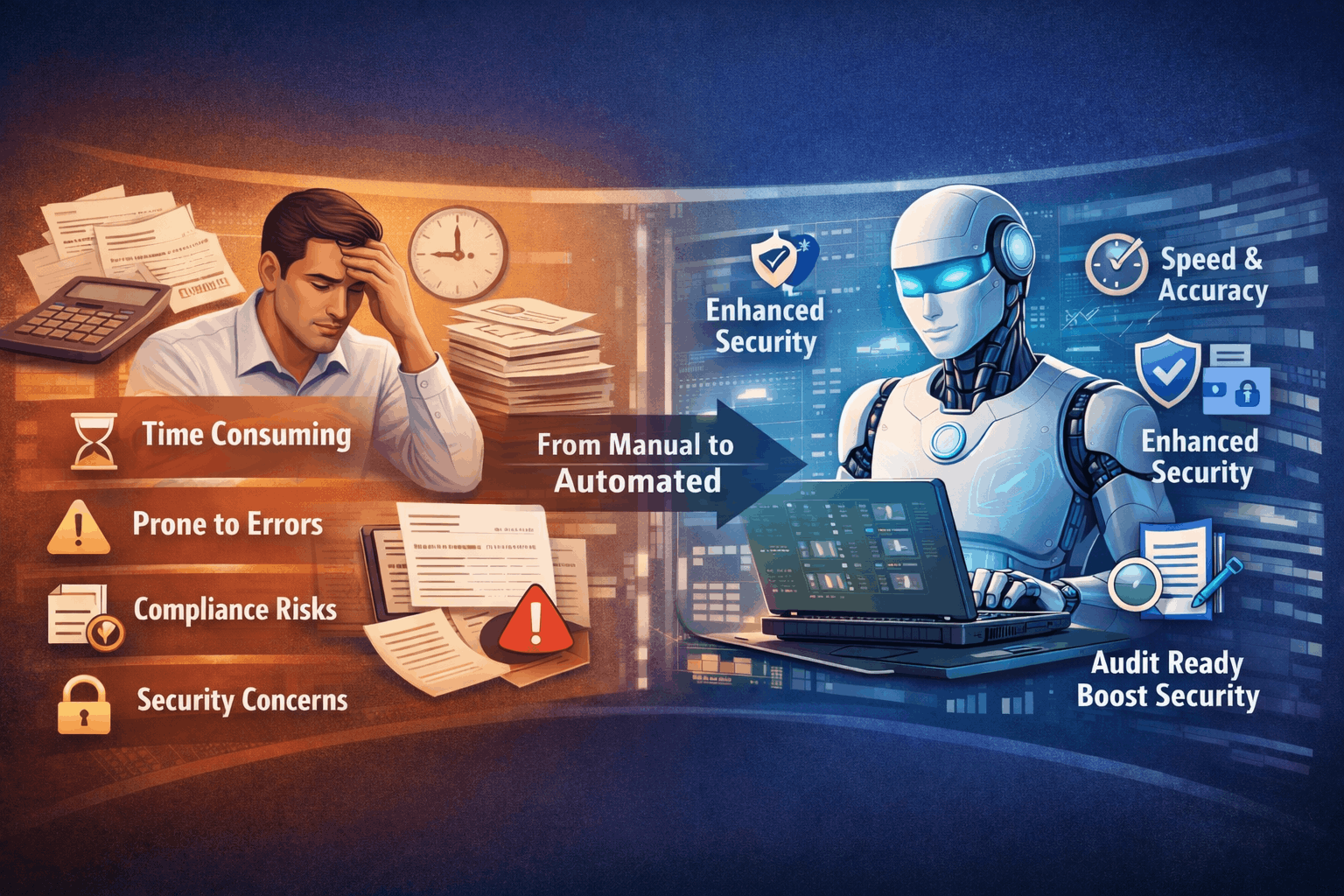
Still Typing Bank Transactions Manually? Here's How AI Does It in Seconds
Manual bank data entry takes hours, introduces errors, and doesn't scale. See how AI extracts every transaction automatically — at 99.9% accuracy in under 60 seconds.
The Hidden Costs of Manual Bank Statement Data Entry
For businesses of all sizes, relying on outdated manual processes for bank statement data isn't just inefficient; it carries significant financial, operational, and reputational risks. These unseen expenditures and vulnerabilities can quietly erode profitability and undermine strategic decision-making.
Time Drain and Operational Inefficiency
One of the most immediate problems with manual financial data entry is the significant time drain. Manual input of bank statement data consumes valuable employee time, often turning hours into days, delaying critical financial reporting, and diverting resources from higher-value tasks like strategic analysis. This inefficiency creates workflow bottlenecks, slows down overall productivity, and makes it challenging to keep pace in a fast-moving business environment. The goal is to reduce time on bank statement data entry, but manual methods inherently prevent this.
High Error Rates and Financial Inaccuracies
Human errors are an inevitable part of manual data entry, leading to miscategorized transactions, reconciliation discrepancies, and ultimately, inaccurate financial records. These inaccuracies can have far-reaching downstream effects, impacting everything from cash flow projections to investment decisions. Solving how to avoid errors in bank statement input is crucial for maintaining financial integrity, yet manual processes introduce a constant risk of costly mistakes that compromise data reliability.
Compliance Risks and Audit Challenges
Inconsistent or incomplete manual data entry can create significant compliance vulnerabilities. During audits, the lack of a clear, verifiable, and standardized data trail complicates preparations, leading to prolonged audit cycles and increased costs. Furthermore, such inconsistencies can expose businesses to regulatory scrutiny and potential penalties, making audit readiness a constant challenge. For insights on managing complex data, explore how to Unlock Audit-Ready CSVs: Master Split Transactions & Wrapped Bank Statement Descriptions.
Security Concerns with Handling Sensitive Financial Data
Manual handling and storage of sensitive bank statement information introduce inherent security risks. Physical documents can be misplaced or accessed by unauthorized personnel, and even digital manual processes might lack the robust protections of specialized systems. The potential for data breaches, coupled with a lack of clear, automated audit trails, makes manual methods a less secure option compared to enterprise-grade automated systems designed for financial data protection. Learn more about safeguarding your information in our guide to Secure PDF Bank Statement to CSV Conversion.
Revolutionizing Financial Processes: AI as the Automated Alternative to Manual Data Entry
Bank Statements CSV offers an AI-powered automated alternative to manual data entry, transforming how businesses manage their financial data. This section presents AI automation as the definitive solution to the challenges of manual bank statement processing, highlighting its core benefits in accuracy, speed, and overall operational enhancement.
Unlocking Unparalleled Accuracy and Data Integrity
AI-driven systems leverage advanced algorithms to precisely extract transaction data from diverse PDF layouts, drastically reducing errors and ensuring reliable, consistent data for critical financial tasks. Bank Statements CSV boasts a 99.9% accuracy rate, making it a powerful solution for how to avoid errors in bank statement input. This level of precision ensures that financial analysis, reconciliation, and reporting are based on trustworthy data, eliminating the guesswork and manual checks associated with traditional methods. Discover how to achieve this without data loss: How to Convert Bank Statements PDF to CSV Without Data Loss (100% Accuracy).
Dramatically Reduce Time on Bank Statement Data Entry
One of the most immediate and impactful benefits of AI automation is the dramatic reduction in processing time. What once took hours of laborious manual input can now be completed in minutes, often within 30-60 seconds per statement. This transformative speed allows finance teams to shift their focus from arduous data entry to valuable analysis and strategic planning. It is the ultimate solution to reduce time on bank statement data entry and enhance overall team productivity. To learn more about this efficiency, read our article on how to Automate Bank Statement Data Entry with AI.
Enhanced Security and Data Protection
Professional AI automation services prioritize robust security protocols, providing a far more secure environment than manual data handling. Bank Statements CSV employs enterprise-grade encryption for all uploads, processes files only temporarily during conversion, and immediately deletes them after the CSV is generated. This ensures sensitive financial data is protected at every step, offering peace of mind and significantly mitigating risks associated with manual storage and access. For details, refer to our Privacy Policy and Data Deletion Policy.
Strategic Applications: Automating Bank Statement Entry for Key Financial Workflows
AI automation provides tangible benefits by streamlining critical financial processes, offering direct solutions to the inefficiencies of manual bank statement entry.
Streamlining Monthly Reconciliation and Closing Cycles
Manually reconciling bank statements is a notoriously laborious and time-consuming process, often leading to frustration with manual transaction logging. AI automation, however, transforms this by quickly providing clean, organized CSV files that are instantly compatible with software like Excel and QuickBooks. This rapid, accurate, and error-free approach significantly speeds up month-end closes, reduces discrepancies, and frees up accounting professionals for higher-level tasks. For a comprehensive guide, see Your Complete Guide to Bank Statement CSV for QuickBooks Reconciliation.
Expediting Loan Application and Underwriting Processes
For lenders and financial institutions, manual bank statement review is a major bottleneck in loan application and underwriting processes. Automated bank statement processing provides instant access to clean, verifiable transaction data, accelerating loan application reviews, improving risk assessment, and significantly reducing the manual review burden. This allows for faster approvals and a more efficient lending operation.
Simplifying Audit Preparation and Compliance Reporting
Preparing for audits manually involves time-consuming aggregation, verification, and organization of financial data, often presenting compliance challenges. With AI automation, businesses can seamlessly generate audit-ready CSV files with accurate, consistent, and transparent transaction histories. This not only ensures compliance with regulatory requirements but also simplifies the entire audit preparation process, reducing stress and potential penalties.
Industry-Specific Advantages of Automated Bank Statement Processing
AI automation offers tailored solutions that address the unique challenges of manual data entry across various sectors, significantly improving financial operations.
For Lending and Credit Assessment: Speed and Precision
In the lending and credit assessment industry, speed and precision are paramount. Automation helps lenders quickly and accurately analyze borrower financial health by processing bank statements rapidly. This leads to reduced loan processing times, improved risk assessment models, and more informed lending decisions, ultimately enhancing customer satisfaction and operational efficiency.
For Real Estate Management: Tenant Accounting and Expense Tracking
Property managers often grapple with large volumes of bank statements for tenant accounting and expense tracking. AI automation enables them to quickly process rental income, security deposits, and operational expense statements. This ensures accurate tenant ledgers, simplifies property financial oversight, and provides real-time insights into property performance, eliminating the frustration with manual transaction logging for property-related finances.
For Small Business Accounting: Simplified Bookkeeping and Tax Readiness
Small businesses frequently face significant problems with manual financial data entry, diverting precious time and resources. Automated bank statement processing simplifies bookkeeping by converting complex PDF statements into easily manageable CSV files. This leads to cleaner books, more straightforward tax preparation, and better overall financial health insights, empowering small business owners to make smarter financial decisions without the manual burden. Discover more ways to boost productivity with our Essential Guide to PDF to CSV Bank Statement Conversion.